

Imagine a trading world where your portfolio works for you 24/7, seizing opportunities on decentralized exchanges (DEXs) with the precision and adaptability of AI. That’s not just tomorrow’s promise, it’s today’s reality for traders who harness the synergy of AI trading bots and DEX integration. If you’re ready to automate your edge and surf the DeFi wave, this guide will walk you through the practical steps and essential tools for building your own AI-powered crypto bot for DEXs.
Why Integrate AI Trading Bots with Decentralized Exchanges?
Decentralized exchanges like Uniswap and SushiSwap have transformed crypto trading by eliminating middlemen, putting users in control of their assets, and enabling transparent, peer-to-peer trades. But this freedom comes with challenges: volatile price swings, liquidity fluctuations, and a relentless 24/7 market that can be overwhelming for even the most dedicated human traders.
AI trading bots step into this environment as tireless agents, analyzing vast data streams, executing trades at lightning speed, and learning from every market tick. Integrating these bots with DEXs means you can automate complex strategies like arbitrage, liquidity provision, or momentum trading while retaining full custody over your funds. The result? Smarter decisions, reduced emotional bias, and a competitive edge in an increasingly agentic DeFi landscape.
The Essential Stack: Tools and Libraries for AI Bot DEX Integration
Success starts with choosing the right technology stack. Here are your must-haves:
Top 5 Python Libraries for AI Crypto Bots on DEXs
- Web3.py – The go-to Python library for interacting with Ethereum-based decentralized exchanges. Web3.py enables your bot to connect, read blockchain data, and execute trades via smart contracts, making it essential for DEX integration.

- ccxt – A powerful library for connecting to hundreds of crypto exchanges, including support for select decentralized exchanges like Uniswap and dYdX. ccxt simplifies API management and trading operations for your bot.
- Pandas – The industry-standard Python library for data manipulation and analysis. Pandas allows you to efficiently process historical and real-time market data, a crucial step for AI model training and backtesting.
- TensorFlow – A leading open-source machine learning framework from Google. TensorFlow empowers you to build, train, and deploy sophisticated AI models for predictive trading strategies on DEXs.
- PyTorch – An advanced deep learning library developed by Meta. PyTorch is widely used for research and production AI models, offering flexibility and speed for developing neural networks that power your trading bot's intelligence.

- Python: The de facto language thanks to its readability and robust ecosystem.
- Web3. py: Your bridge to Ethereum-based DEXs, connect to nodes, interact with smart contracts, fetch balances, or place trades programmatically.
- Pandas and NumPy: For crunching historical price data or calculating technical indicators like moving averages or RSI.
- TensorFlow/PyTorch: Power up your bot with advanced machine learning models, think LSTM networks for time-series forecasting or reinforcement learning agents that adapt in real time.
- Requests/WebSockets: Pull historical data from APIs like CoinGecko or listen to live price feeds from DEX aggregators.
Coding Your Edge: From Data Collection to Model Training
The journey begins with data, the lifeblood of any successful AI strategy. Start by fetching historical price action from reliable APIs. For example, you might use CoinGecko’s endpoint to load 30 days of Bitcoin prices directly into a Pandas DataFrame:
Fetching Historical BTC Prices from CoinGecko with Python
Let's get hands-on! Here's how you can fetch historical BTC prices for the past 30 days using the CoinGecko API in Python. This data is essential for backtesting your AI trading strategies.
import requests
from datetime import datetime

# Fetch BTC historical prices (last 30 days) from CoinGecko API
def fetch_btc_historical_prices():
    url = 'https://api.coingecko.com/api/v3/coins/bitcoin/market_chart'
    params = {
        'vs_currency': 'usd',
        'days': 30,
        'interval': 'daily'
    }
    response = requests.get(url, params=params)
    data = response.json()
    prices = data['prices']  # Each item: [timestamp(ms), price]
    # Convert timestamp to readable date
    historical_prices = [
        {'date': datetime.utcfromtimestamp(ts/1000).strftime('%Y-%m-%d'), 'price': price}
        for ts, price in prices
    ]
    return historical_prices

if __name__ == "__main__":
    btc_prices = fetch_btc_historical_prices()
    for entry in btc_prices:
        print(f"Date: {entry['date']}, Price: ${entry['price']:.2f}")
With this data in hand, you're ready to move on to analyzing trends or feeding it into your AI models. Let's keep building!
This raw data becomes the training ground for your model. Next up: build predictive models using TensorFlow or PyTorch. LSTM networks excel at forecasting price movements by capturing temporal dependencies, ideal for anticipating those sudden surges or dips that define crypto markets.
Tuning Your Trading Logic
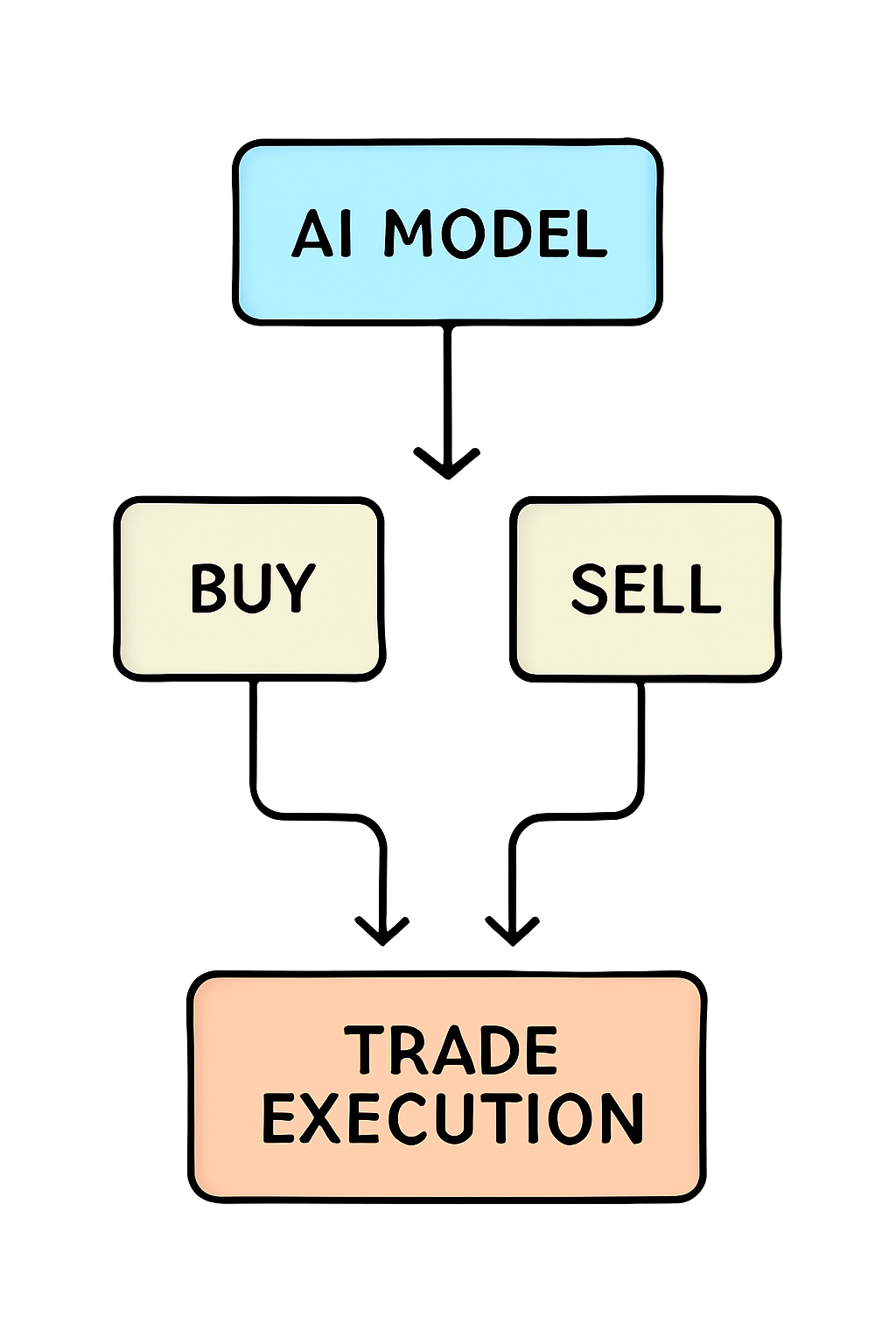
A well-designed bot doesn’t just predict, it acts decisively based on clear rules. For instance: set buy triggers when predicted prices exceed current values by 1%, or sell if they drop below a defined threshold. This logic ensures disciplined execution without hesitation or FOMO-induced errors.
Implementing Basic Trade Logic in Your AI Crypto Bot: Step-by-Step
Pitfalls and Power Plays: Key Challenges in Automated Trading on DEXs
No system is bulletproof, especially in the wild west of DeFi! Market volatility can whipsaw even the smartest algorithms if risk management is ignored. Always set stop-losses and size your positions conservatively. Slippage and gas fees are real profit killers; optimize trade sizes and monitor network congestion before firing off transactions.
The best bots don’t just adapt, they evolve. Regularly retrain models on fresh data to avoid overfitting yesterday’s patterns onto today’s market realities. And never neglect security: audit your smart contract interactions rigorously to avoid costly exploits.
Staying ahead in the DeFi arms race means treating your AI trading bot as a living project, not a set-and-forget tool. The rapid pace of crypto innovation demands continuous improvement, whether that’s adding new DEX integrations, refining your machine learning models, or tuning risk parameters to handle the latest market regime.
Deploying and Monitoring Your AI Bot on DEXs
Once your bot’s core logic is solid and backtested, it’s time to move from theory to live trading. Deploy on a secure server or cloud platform with robust uptime, and don’t skip on monitoring: real-time logs, performance dashboards, and alert systems are critical for catching anomalies before they snowball into losses.
Don’t be afraid to start small, test with limited funds in a simulated or low-stakes environment before scaling up. Use dynamic stop-losses and algorithmic position sizing to help your bot weather sudden volatility spikes. And remember: even the best models can degrade over time if left unmonitored. Schedule regular retraining sessions using new market data to keep your edge sharp.
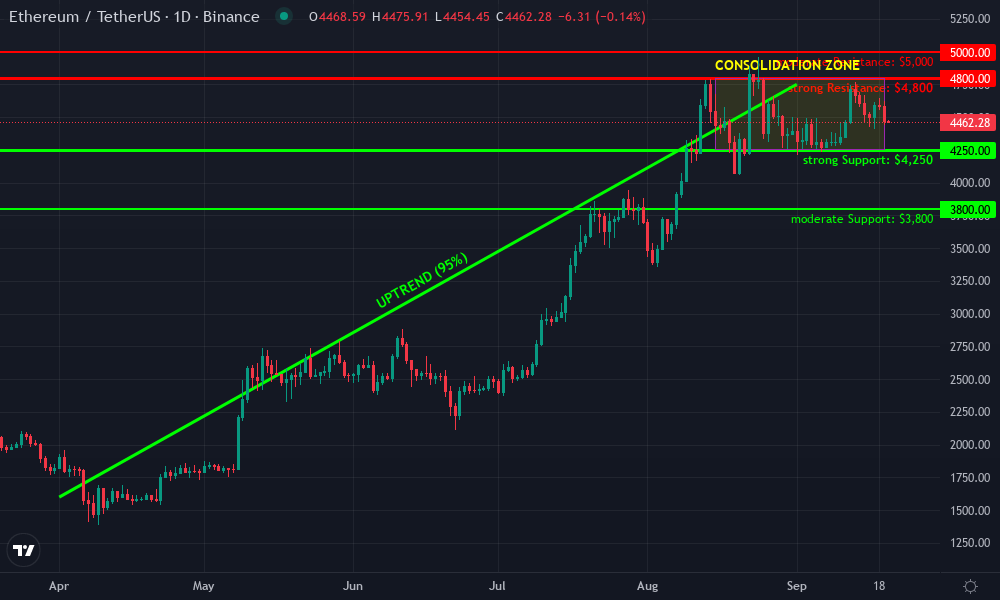
Ethereum Technical Analysis Chart
Analysis by Market Analyst | Symbol: BINANCE:ETHUSDT | Interval: 1D | Drawings: 6
Technical Analysis Summary
For a balanced technical analysis, start by drawing a major uptrend line from late April 2025 around $1,600 to a touchpoint in early September 2025 near $4,750 using the trend_line tool. Mark the consolidation zone from mid-August through September 19, 2025, roughly between $4,250 and $4,800 with a rectangle. Identify horizontal support lines at $4,250 (strong), $3,800 (moderate), and resistance at $4,800 (strong). Use the long_position tool to visualize an entry near support, and the short_position tool if price breaks below $4,250. Annotate recent sideways action with a callout, and highlight profit-taking zones near the $5,000 psychological level with horizontal lines and text. If available, overlay MACD and volume indicators for confirmation signals.
Tags
Related Articles
Autonomous AI Agents for MEV Extraction on Solana: 2026 Setup Guide
In the blistering world of Solana DeFi, where blocks finalize in under a second and MEV extraction fuels network value, autonomous AI agents are rewriting the rules for savvy traders. With Binance-Peg SOL trading at $85.93 after a 2.94%...
Apr 23, 2026
Configuring Autonomous AI Agents for Solana Raydium Liquidity Provisioning 2026
In the pulse-racing world of Solana DeFi, where SOL trades at $85.96 after a solid and 4.63% 24-hour gain, liquidity providers are turning to autonomous AI agents to dominate Raydium pools. These bots don't just watch the charts; they...
Apr 14, 2026
Polymarket Arbitrage Bots for AI Trading Agents: GitHub Tools and Strategies
In the fast-paced world of prediction markets, Polymarket arbitrage bots powered by AI trading agents are reshaping how we capture profits from fleeting inefficiencies. Platforms like Polymarket offer unique opportunities in event-based...
Feb 27, 2026
Build No-Code Polymarket Trading Bots with Claude AI for 93% Win Rates
Imagine turning a simple conversation with an AI into a Polymarket trading bot that racks up 345 wins and just 26 losses - a staggering 93% win rate - all without writing a single line of code. That's exactly what trader sharbel did,...
Feb 20, 2026
No comments yet. Be the first to share your thoughts!